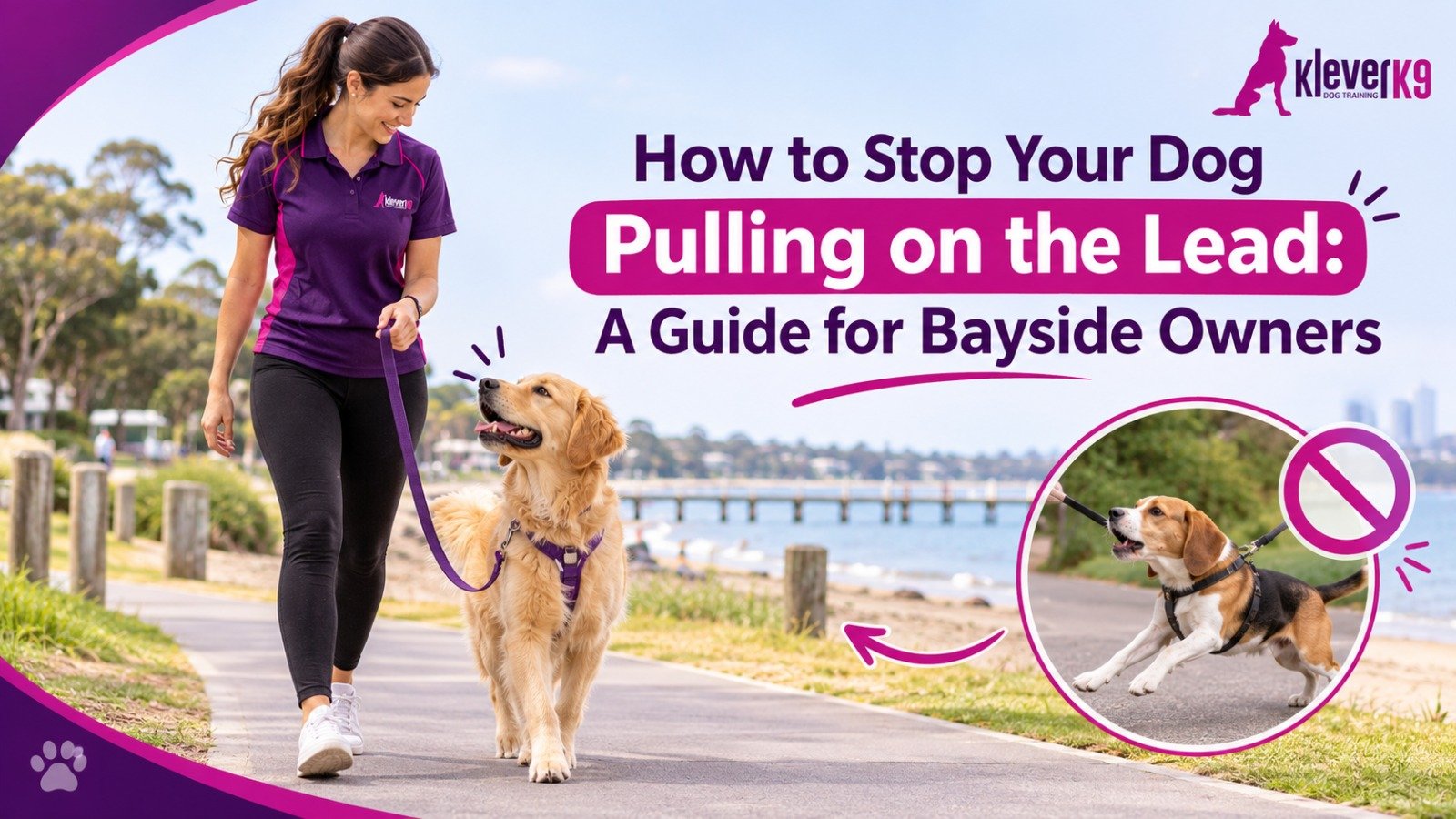
A walk along a Bayside footpath can become hard work when your dog spends the whole trip at the end of a tight lead. There are smells to investigate, dogs across the road and people heading towards the beach. Pulling often gets the dog closer to those things, so it is easy for the habit to become well practised.
Loose-lead walking teaches a different way to get around. Your dog learns that staying within the available lead length makes walks continue and brings rewards. It takes repetition, but the training can start on a quiet stretch near home rather than in the busiest part of the foreshore.
Decide what you want the walk to look like
Loose-lead walking does not require your dog to stare up at you or remain pressed against your leg. For an ordinary walk, the aim is a comfortable lead with room for the dog to move and sniff without dragging you.
You can teach a closer position for narrow paths or passing people, then release your dog to explore again where there is space. That distinction makes the task more reasonable. Expecting formal heelwork for an entire outing can leave both of you frustrated.
Choose a simple reward word, such as “yes”, to mark the moment your dog gets something right. Say it as the lead is loose or your dog checks in, then deliver the reward promptly. Timing helps the dog connect the reward with the behaviour you want.
Start with suitable equipment
Use a comfortable, correctly fitted harness or collar and a lead you can manage securely. A harness may help avoid pressure on the neck, but fit and individual needs matter. Ask a reward-based trainer for help if your dog slips equipment or you struggle to handle their strength.
Equipment can make management easier; it does not teach the whole skill. Avoid relying on jerks, pain or intimidating corrections. If your dog is already worried by nearby dogs or traffic, unpleasant experiences can add to the problem.
Carry small rewards your dog likes and can eat easily. Account for training food in their daily intake and follow dietary advice if they have health restrictions. You will get more useful repetitions from several small pieces than from a large chew that takes a minute to finish.
Teach the first few steps somewhere quiet
Begin indoors, in a secure garden or on a very quiet section of footpath. Reward your dog for standing near you with the lead relaxed. Take one or two steps. If your dog moves with you without tightening the lead, mark and reward beside your leg.
Repeat over short distances, gradually adding steps between rewards. Reward placement matters: continually reaching far ahead can encourage the dog to surge forward. Keep your hand near the position you want the dog to return to.
Finish while things are going well. Five useful minutes are better than a long session in which your dog becomes tired and you become impatient. You can practise again later rather than trying to solve every walk in a single afternoon.
What to do when the lead goes tight
Where it is safe, pause instead of allowing pulling to carry your dog all the way to the interesting smell. Encourage them back towards you or wait for a small release in tension, then reward and move again.
You can also turn gently towards a less distracting direction before the lead tightens. Avoid suddenly dragging your dog around. Your goal is to help them succeed at walking with you, not to create a contest over who can pull harder.
If you stop every second and nothing improves, make the exercise easier. Move away from the distraction, use a quieter location or reduce the session length. Repeating the same difficult setup is not necessarily giving your dog useful practice.
Let sniffing work in your favour
Sniffing is part of a dog’s walk, so use access to suitable sniffing spots as a reward. When the lead is loose, give a release cue and move towards the verge together. The dog learns that a relaxed lead can lead to something worthwhile.
Alternate short training stretches with sniffing breaks. This is often more manageable than trying to control every step. Keep your dog away from dangerous items and respect private gardens and other people’s space.
For example, you might practise along a quiet residential stretch in Hampton, then allow a sniffing break in an appropriate area. A busy beach entrance with dogs arriving from several directions can wait until the foundations are stronger.
Pulling towards dogs needs a closer look
Some dogs pull because they want to greet. Others pull, bark or lunge because they are uncomfortable and want the other dog to move away. The outward behaviour can look similar, but the training plan may differ.
Give your dog more distance before they become overwhelmed. Cross the road where safe, turn into a quieter street or step well aside. Reward calm attention and allow recovery time. Do not force a greeting because someone says their dog is friendly.
Seek help if your dog repeatedly lunges, cannot settle after seeing another dog or makes you worry about losing control. A veterinary check is sensible when behaviour changes suddenly. Klever K9’s private training options include lead manners and reactivity, allowing the actual walking situation to be assessed.
Plan Bayside walks around the surroundings
Brighton, Sandringham and Beaumaris offer very different distractions depending on the time and location. Choose quiet periods while training is new, and leave extra space around runners, cyclists and children.
Check current Bayside City Council rules and signs before heading onto beaches or reserves. Dog access conditions vary by place and season. An off-leash designation does not mean every dog should be unclipped while recall or control is still unreliable.
On warm days, choose cooler conditions and check whether the surface is comfortable for your dog. A shorter, calmer outing can be more useful than insisting on the usual route when the environment is making everything harder.
Notice progress in small, useful changes
Measure whether your dog can pass one driveway without pulling, recover more quickly after a distraction or offer a check-in without being prompted. Those changes show the skill developing even if the entire walk is not yet easy.
Make sure everyone walking the dog uses a similar approach. A lead kept loose through patient practice is easier to maintain when pulling does not work on every second outing. Build from the quiet street to the busier path at a pace your dog can handle.