Your puppy can sit beautifully in the kitchen, then forget you exist when another dog appears. Or perhaps the real problem happens at home: toilet accidents, biting trouser legs and frantic barking when visitors arrive. These situations call for different kinds of practice, which is why the choice between puppy school and in-home training is rarely settled by price alone.
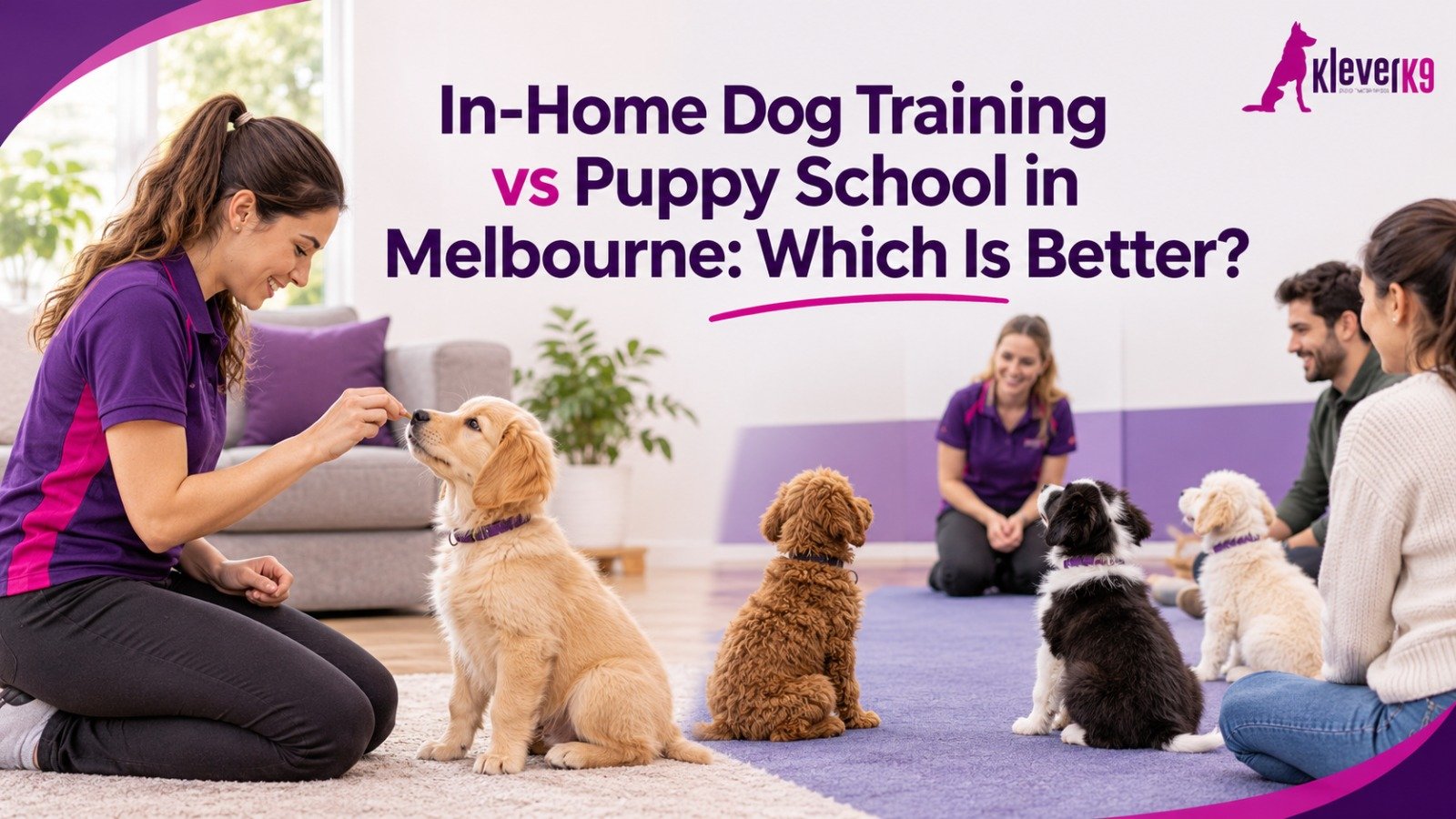
Both can be useful. Puppy school offers a structured group setting, while private training lets someone work closely with your household and the situations you face. Some Melbourne families benefit from using both at different stages.
What a good puppy school offers
Puppy school introduces owners to training skills and gives young dogs carefully managed experiences around unfamiliar people and puppies. You should learn how to reward useful behaviour, recognise when your puppy needs a break and practise basic cues in short, achievable steps.
The group environment creates distractions that are difficult to reproduce in your lounge room. Your puppy can practise noticing another dog without having to rush over. You can also see the instructor demonstrate timing and handling, then receive help while you try.
A good class is not an hour of uncontrolled puppy play. Size, confidence and play style should influence any interactions. A shy puppy hiding under a chair should not be pushed into the middle of the group to “get used to it”. Watching calmly from a comfortable distance can be a worthwhile lesson.
Where in-home training helps most
A trainer visiting your home can see the actual problem and the surroundings that contribute to it. That may include the front gate, the narrow hallway where your dog jumps on guests or the back door used for toilet training.
Private sessions also give your family time to ask detailed questions. If one person rewards jumping while another tries to discourage it, the trainer can help everyone agree on a practical response. Children can learn appropriate ways to interact, with adult supervision and arrangements that protect both child and dog.
For Melbourne households with several pets, unusual work hours or difficulty travelling, a home visit may be easier to organise. It also lets the trainer adapt the session around your dog’s concentration and confidence, rather than the pace of a whole class.
Socialisation is broader than meeting dogs
A puppy needs positive experiences of everyday life, including household sounds, different surfaces, visitors and calm handling. Socialisation is about developing confidence around those experiences. It does not require greeting every person or playing with every dog you pass.
RSPCA guidance recommends reward-based experiences and giving puppies a choice to approach or move away. If a puppy becomes worried, reduce the pressure. Repeatedly keeping them close to something frightening can make the experience worse.
This work continues outside class. A carefully planned outing might involve watching a quiet street from a safe distance, then going home before your puppy becomes tired. Your vet can advise on local disease risks and appropriate outings during the vaccination course.
Check vaccination requirements before enrolling
Ask the school about age limits, vaccination requirements and hygiene procedures. Discuss those requirements with your vet, particularly if your puppy has health concerns. Avoid treating either complete isolation or unrestricted public dog-park visits as the only options available.
A suitable class can form part of early socialisation, but the environment and your puppy’s health matter. Keep an unwell puppy home and tell the instructor so you can discuss catching up.
Match the format to the problem
Puppy school may be a good fit when your puppy is within the class age range, can cope with a group environment and you want help with the foundations. It can also provide useful practice for owners who are new to reading canine behaviour.
Private training may be more suitable when you need detailed help with a household routine, your dog becomes overwhelmed around others or the problem is difficult to recreate in class. Older dogs may benefit from an age-appropriate group course or private sessions, rather than being placed in a puppy class.
A sudden behaviour change deserves a veterinary check. Pain, illness or sensory changes can affect how a dog behaves. If there is a bite risk, severe fear or distress when left alone, ask about suitable professional support instead of assuming a standard obedience class will cover it.
Questions worth asking a trainer
Before paying, ask how the sessions are run and what happens if your dog struggles. Useful questions include:
- Do you use reward-based training throughout?
- How many puppies and instructors attend each class?
- Can a worried puppy work at a greater distance or take a break?
- What practice will we receive to do at home?
- Can the whole household learn the same handling approach?
- When would you recommend veterinary or specialist behaviour help?
Look for clear answers, realistic expectations and a willingness to adjust. Be wary of promises to permanently fix a complex problem in one session or advice based on frightening, hurting or overpowering the dog.
Compare what the fee includes
A group course often costs less per session than private tuition, but the useful comparison is what your household needs. A private consultation may include a written plan and time spent investigating a specific difficulty. A course may offer several opportunities to practise around controlled distractions.
Check session length, travel arrangements, missed-class policies and whether follow-up support is included. A cheaper option that you cannot attend consistently may be less useful than a format that fits your week.
Klever K9’s training services include in-home and mobile training, puppy consultations and group courses. Its listed group venues include Malvern and Narre Warren North, so Bayside owners should check the current location and timetable before enrolling.
What combining the two can look like
A family might start with a home consultation to establish toileting, rest and visitor routines, then join puppy school for supported practice around other puppies. Another household may begin in a class and arrange a private session when a specific problem becomes clear.
There is no need to buy every option at once. Tell the trainer what daily life looks like, what your puppy finds difficult and what your family can realistically practise. A few minutes of consistent work between sessions matter more than collecting course certificates.
Choose the setting where your dog can learn and you can understand what to do next. As your puppy grows, that setting may change, and the training plan should change with it.