
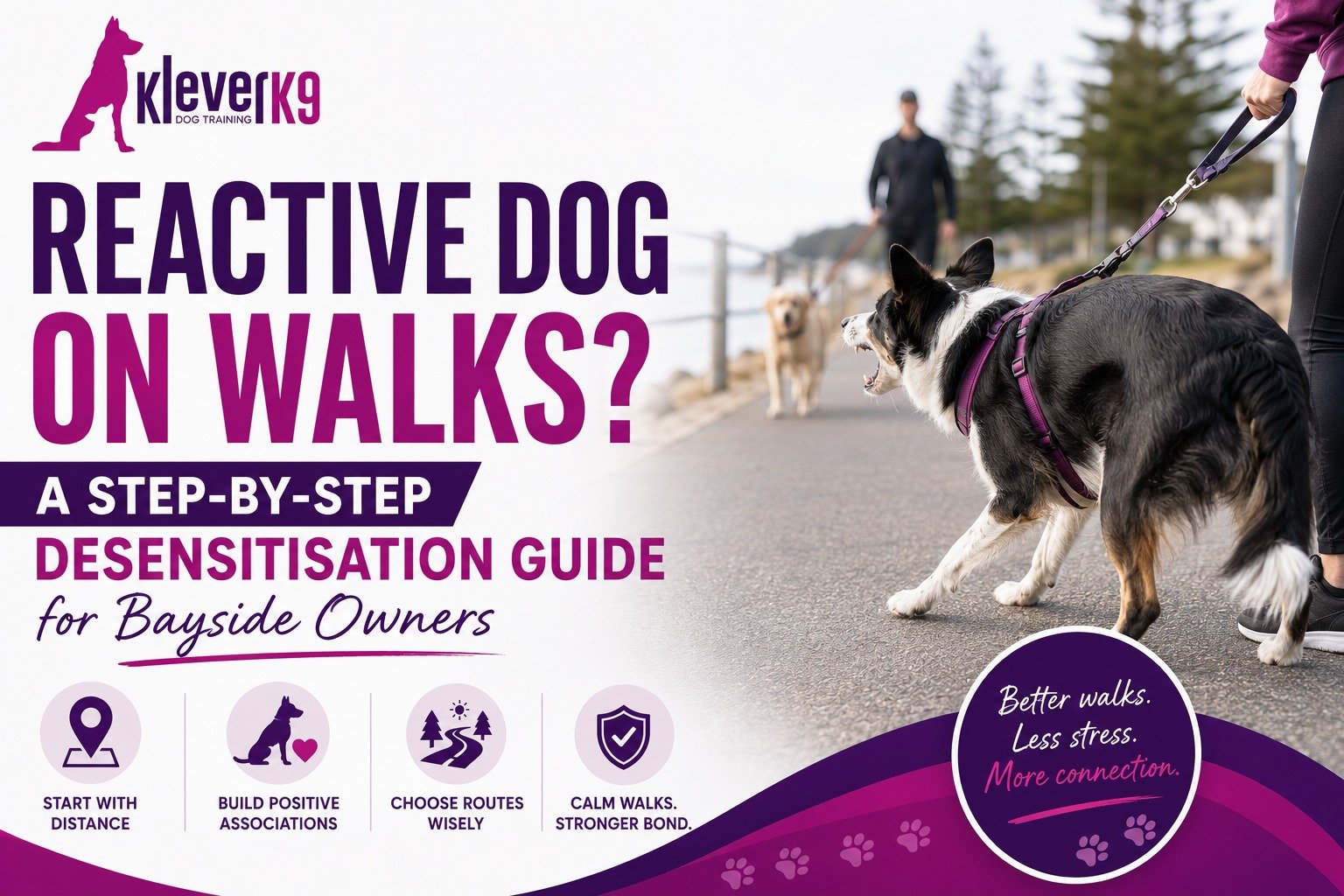
Why Bayside walks can be a challenge
Living near Bayside means plenty of good walking routes, but also plenty of other dogs, cyclists, prams, and general foot traffic, which is exactly the kind of environment that turns a reactive dog’s daily walk into a stress test for everyone involved. If your dog lunges, barks, or freezes the moment it spots another dog half a block away, you’re not alone, and it’s very much a solvable problem. It just takes a structured approach rather than hoping the behaviour improves on its own.
Start with distance, not exposure
This is the part most owners skip because it feels like giving up ground, but it’s the entire foundation of desensitisation work. Find the distance at which your dog can see a trigger, whether that’s another dog, a jogger, or whatever sets them off, and still take treats, respond to their name, and generally function.
That distance is your starting point, even if it means:
- Crossing the road
- Walking in a car park
- Working from fifty metres away rather than five
If your dog is already barking and lunging, you’re too close, full stop.
Building good associations slowly
From that safe distance, the goal is simple. Trigger appears, good things happen. Every time your dog notices the other dog calmly, mark it and reward generously, using a high value treat rather than the same dry biscuit they get for sitting at home.
Over repeated sessions, the sight of another dog starts to predict good things rather than danger, which is the whole point of counter conditioning. This is slow work. Progress in reactive dog training is measured in weeks and months, not single walks, and trying to rush the distance closer before your dog is ready usually sets things back rather than forward.
Choosing your time and route wisely
Timing matters as much as distance. Early morning or late evening walks around Bayside tend to have fewer surprise encounters than the middle of the day, which gives you more control over your training sessions. Scouting your route in advance, literally walking it once without your dog to check for blind corners, off leash areas, or narrow footpaths, saves you from ambush encounters that can undo weeks of careful work in a single bad moment.
Reactive is not the same as aggressive
It’s also worth separating “reactive” from “aggressive,” because a lot of owners assume the worst about their dog when the behaviour is actually rooted in fear or frustration rather than a desire to fight. A dog frustrated because it wants to greet other dogs and can’t reach them looks a lot like an aggressive dog from a distance, but the underlying training approach is quite different.
This is exactly the kind of thing that’s much easier to sort out with someone watching your dog in person, in your own neighbourhood, than trying to interpret advice written for a generic reactive dog. If walks have become something you dread rather than enjoy, working through a desensitisation plan with in home guidance, where the trainer can walk your actual route with you and adjust the plan on the spot, tends to get results a lot faster than trial and error alone.